Jun 18, 2013

Painted Skeletons & Amputation Saws

I entered the room and gasped -- it was Death draped in red.


A skeleton posed elegantly on a chair, in an attitude suggesting a woman lost in a private thought at a cocktail party, her feet lapped in red velvet pooled at the base of the display. It was shockingly beautiful. The bones were threaded with blue veins and covered in vermilion arterial vessels, so delicately wisped that it looked like a red feather skirt puffed out around the skeleton's hips. I couldn't stop thinking of it as a woman. The bones were yellow like dead skin, gristly and crackling at the fingertips and toes. Teeth look gawky and protruding without a sheet of skin to cover them, but hers are still pearly-white and perfectly straight.

The International Museum of Surgical Science is possibly Chicago's strangest museum (possibly -- I'm still willing to test this.) Alongside the gleaming affluent sprawl of Lake Shore Drive is a statue of a stoic-faced man holding a quailing sick man up by his arms; behind that are four stories of artifacts and information about surgery. I started getting excited and taking notes once I passed a placard about congenital analgesia -- a rare genetic disorder that makes you unable to feel pain. Most sufferers are dead by age 25 because of little things like burns or joint pain (they never feel uncomfortable, your body's signal to shift position.) I am not a scientific-minded person at all, so I went through this as an art and history museum.

You are greeted by a glistening gurney on the first floor. Then, a little further up, is a sign on the door to an exhibit:

VISITORS PLEASE NOTE: You are about the enter the prenatal gallery...

Which of course sounded promising. The room was dimly lit with a subterranean glow, each exhibit in its own floodlight. There was a long table of fetuses in various stages of development contained in glass vials, their minuscule little bones tinted red. They seemed to glow with blood. The whole exhibit was haunting, but these especially. So delicate and small... like human tadpoles. In a glass case in the corner of the room was a 7-week-old fetus lying on its side, attached to a placenta. Its skin was like a wrinkled white peach, with a thin dusting of brown hair on its head and eyebrows inclined heartbreakingly upwards. There was also a fetal victim of Sudden Infant Death Syndrome, next to a conjoined-twin fetus that looked like something you'd see unveiled with a flourish at a carnival freak show.


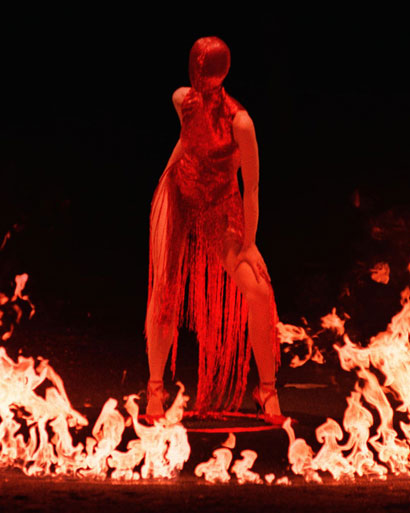
The museum was not solely populated with dead bodies, though. There was a whole cabinet of artificial legs and arms, a gynecological instrument from ancient Rome -- vagina specula -- and a plaster copy of Napoleon's death mask. I was struck by how flat-out attractive Napoleon was in death; with his paunch gone, cheeks narrowed down with the smooth bones accentuated, narrow lips, and aquiline nose, he was really beautiful. Walking through this museum produced a strange combination of feelings in me: I felt at once reverent, repulsed, and sensuously preoccupied with the structure of the human body. In the same room as Death draped in red (pictured above,) I saw the arteries of an infant's legs hanging suspended in a glass case and could not stop shivering until I turned away.

Entire passages and floors of the museum were relatively untainted with the odor of death, but naturally those don't stick as much in my mind -- exhibits about eyeglasses, hearing trumpets, X-rays, polio, painkillers (very interesting for tracing the history of intoxication, addiction, and big-business drugs in America)... One thing I realized: nurses are, aesthetically, very much like angels. That has to be on purpose. There was a bust of Florence Nightingale on one of the staircases, in white of course, and she had her eyes rapturously-yet-demurely upturned like the Virgin Mary. There is an atmosphere of care as opposed to violence in this museum, even though the history of the profession is bloody and gruesome by necessity.

Without the cushioning distraction of a gift shop to speak of I walked back out into the sunshine three hours later, my breath shallow and caught in my throat, feeling almost unbearably attuned to life.

Apr 25, 2013

Unremitting Disgust

This is a paper that I wrote as a final project for a class called The Power of Food in Literature, Culture, and Film (just ending -- I present this paper next week.) The full title is:

"Unremitting Disgust: The Culinary Experience of The Texas Chain Saw Massacre."

It's not exactly journalism, but I'm pretty proud of it as a media analysis and so thought I'd post it here. Enjoy. Bring a bucket.


Tobe Hooper’s The Texas Chain Saw Massacre (1974) is considered by many to be the first “slasher” or “splatter” film in the genre of horror. This distinction, while thoroughly deserved, is striking because there is almost no blood used for the film’s special effects. The unique atmosphere of unremitting disgust, terror, disorientation and chaos is created through the tactical use of organic decay – the butchery of farm animals, rotting meat and flesh, strewn chicken feathers and bones. The film’s power also comes from how the story plays off of deep-seated fears and taboos that are held about cannibalism in American society, blurring the line of distinction between human and animal meat. This comes to a head in the notorious “dinner scene” where Sally (the only victim to escape) is both the guest and the main course. The forced intimacy of this dinner invitation is heightened by the fact that Sally is completely under the control of her captors – she is tied to her chair, screaming, but is still given a plate of food and spoken to with a grisly-absurd kind of Southern hospitality. The Texas Chain Saw Massacre remains one of the most effective and artfully done horror films today, yet it cannot be described as gory. The images of rotting flesh, human butchery, animal detritus and decay throughout the film strike a very deep chord of disgust and fear in the viewer.

The Texas Chain Saw Massacre is only one in a chain of films inspired by the true-crime story of Ed Gein – others include such touchstone works as Psycho and The Silence of the Lambs – which continues to fascinate today. Gein was a reclusive farmer in rural 1950’s Wisconsin who robbed graves and killed women to obtain body parts that he used to make crafts and costumes (face-masks, leggings, even a vest made of real breasts – a very primitive form of transvestism.) There were rumors of evidence of cannibalism found at Gein’s house, which were later revealed to be unfounded.

“It wasn’t long before the facts surrounding Bernice Worden’s murder – horrific enough to begin with – underwent some significant alterations. Mrs. Worden’s heart, for example, which had actually been discovered in a plastic bag near Eddie’s stove, was suddenly reported to have been found in a frying pan on one of the burners. The old suit of clothes in which her entrails had been hidden became a refrigerator packed with vital organs, all of them neatly wrapped in butcher’s paper. Stories began to circulate that the widow’s body had been dismembered and her legs hung up to cure in Gein’s summer kitchen. Eddie’s cellar was rumored to be stocked with quart jars full of human blood” (Schechter 93).

Ed Gein’s acts were so shocking and debased because the ways he used human bodies bespoke no understanding of their humanity, so cannibalism would not be a far leap – in a certain way, it would make more sense than his taxidermy-esque efforts. Nevertheless, the story of Ed Gein’s cannibalism persists. This hearsay about the horrific goings-on at the Gein farmhouse sparked the imagination of Tobe Hooper to create The Texas Chain Saw Massacre, with cannibalism combined with grave-robbing and some more bizarre fetishes besides. A particular rumor that seemed to scare the inhabitants of Gein’s small Wisconsin town the most was that of collective, unwitting cannibalism. As Schechter goes on to say, “The stories of Ed Gein’s cannibalism generated even ghastlier rumors – that the little man had handed out packages of human flesh to his neighbors, passing the meat off as venison – and local clinics suddenly found themselves trying to cope with an epidemic of gastrointestinal complaints” (119). This concept is explored in detail in Hooper’s film.


The group of five teenagers who become the victims of the wild, inbred Texas family first encounter the father as a seemingly-affable proprietor of a local gas station. They stop for gas and barbecue  which is revealed later in the film to be made of human meat. By this action an interesting spiral is created, where capitalistic consumers become complicit (however unwittingly) in the taboo consumption of human flesh, later to become consumed themselves (Merritt 202). All three generations of the family of killers are ex-abattoir workers who have continued using their skills to butcher ensnared humans and sell them as barbecued meat. They also make knick-knacks and furniture out of their bodies, a practice directly inspired by Gein. Leatherface, the burly older brother who kills his victims as swiftly and efficiently as if they truly were cattle, wears a mask made of flayed human skin.

An invitation to dinner is first extended to the band of teenagers when, after leaving the gas station, they pick up a hitchhiker who happens to be the youngest member of the Family. It becomes immediately clear that The Hitchhiker is very bizarre, twitchy and somehow revolting. Franklin, a member of the group, starts asking him about the old slaughterhouse where his grandfather used to sell his cattle and finds that the Hitchhiker’s family had been laid off from their jobs there, as a result of new technology. Merritt describes how, “While the Hitchhiker explains in an ironically coded way: ‘My family’s always been in meat’ (a description that gathers multiple meanings as the film progresses), Franklin is unwittingly close to the truth when he mutters a disgusted response: ‘A whole family of Draculas’’’ (213). This scene inside the van is cut between shots of the lines of cows confined in the slaughterhouse, foaming and dripping at the mouth from the strong Texas heat. The Hitchhiker gets very excited talking about how the cattle used to be killed by sledgehammer, and how his brother could make a great head-cheese from the remains. He invites the teenagers over to their house to try some, but they decline saying that, “We’re kind of in a hurry,” because by now everyone in the van is feeling a little uneasy and sickened by the whole conversation. They throw the Hitchhiker out after he cuts himself across the hand, smiling with glee, and drive away as he smears his blood across the door. 

The members of the group stumble one by one into the house of these killers, situated very close to where they are staying, and one by one are slaughtered by Leatherface (wearing a white butcher’s apron). They are clubbed over the head, hung on meat hooks, dismembered with a chainsaw, and stuffed into freezers. Sally, the last member to be caught, manages to almost escape after she witnesses Franklin being sawed to pieces. But when she runs back to the gas station in town, frantic and terrified, she is beaten and hauled back to the house by the father (whom the family refers to as The Cook.) There is a very striking, brief but quiet scene where Sally is sitting in the gas station believing she is safe – she is shaking and half-crying, gazing around the store, and spots a rack of grilling sausages bathed in hot red light. The camera lingers on the meat for a few seconds, seeming to imply something that Sally has begun to realize. The moment is quickly shattered by the father attacking Sally with a broom, but still serves to enhance the slaughterhouse atmosphere of the whole film. 


When the Hitchhiker sees that his father has brought Sally home, he recognizes her from earlier in the van and shouts laughingly, “I thought you was in a hurry!” She has now been forced to accept his dinner invitation, as she learns the true nature of this family’s business. The dinner scene soon follows, which Merritt offers some pertinent observations on: “Transgressive themes that destabilize the distinctions between human/animal, consumer/consumed, build to a sadistic climax during the ‘dinner party’ scene, where Sally is both guest of honor and ‘main course.’ In this parody of a domestic scene, perverted small-town hospitality, demented family values, unrepentant sadism, childish bullying, and cannibalism are absurdly combined” (224). Heightening the sense of domestic parody, Leatherface has now slathered makeup on his mask of human skin and put on a nice blue dress. Cook coos to Sally, while giggling at her terror, “Now young lady, you just take it easy there now. We’ll fix you some supper in a few minutes” (Hooper). Sally is given the odd courtesy of a plate of food (two sausages and some mashed potato), napkin, fork, and glass of water – although she cannot move to reach them because her hands are tied to the arms of the chair. When the Hitchhiker wheels his decrepit and near-dead Grandpa into the room, he pricks Sally’s finger and gives it to the old man to suckle. He does so, turning Sally into another kind of consumable and horrifying her so much that she faints momentarily.


When she regains consciousness and dinnertime resumes, the discussion turns to killing and who should have the pleasure of slaughtering Sally. Her screams and pleas do nothing to dissuade the members of the family, who laugh and mock her continuously from across the table while the father attempts to comfort her. He says, “‘Now just you hush. It won’t hurt none. Ol’ Grandpa’s the best killer there ever was. Why he never took more than one lick they say’” (Merritt 227). Over thirty hours were spent filming this dinner scene, and the cast describes how the combination of unbearable 100° F heat and rotting food on the table contributed to the very real hysteria and revulsion of the scene (Shellady). The headcheese had to be changed out every half hour because it kept rotting so quickly. The sausages on the table were injected with formaldehyde at intervals to prevent them from exploding in the heat. There were black curtains over the window, so they could film during the day, so the heat was even more intense – there was a chicken head nailed to a board in the middle of the table that got very grisly and rotting as time went on. People involved in working on the film describe how there were actually buckets placed around the edge of the set for people to vomit into if they needed to. In this kind of atmosphere, with this kind of decay and stench surrounding them, the actors were able to slip completely into their sadistic characters and give a truly insane performance. 


The filth and detritus of dead animals and humans that litters the killer family’s house (one kind of detritus sometimes indistinguishable from another) overwhelms the viewer with a sense of disgust and claustrophobia. This sensation plays off of the fear centers of the mind, while bringing up a very primal, ancient taboo about cannibalism and humans being hunted for meat. One major lesson to take from The Texas Chain Saw Massacre is to never underestimate the sensory power of organic decay, combined with horrifying and taboo implications, to provoke a greater response in a horror film than would be obtained through using buckets of blood. The film also drives home the intimacy and vulnerability suggested by a dinner invitation, especially one received from a stranger. The family wants the five teenagers for devious purposes, and eventually gets them – they ensnare Sally and tie her to her chair, relishing her forced compliance with their invitation and taking their time with the ultimate purpose of slaughtering her on the dining-room floor. She does escape in the end, but just barely – and there is no doubt by the end of the film that this “whole family of Draculas” will be able to carry on with all of their family traditions. 


Bibliography / Filmography

Hooper, Tobe, dir. The Texas Chain Saw Massacre. Bryanston Pictures, 1974. Film. 

Merritt, Naomi. “Cannibalistic Capitalism and other American Delicacies: A Bataillean Taste of
The Texas Chain Saw Massacre.” Film-Philosophy 14.1 (2010). Web. 

Schechter, Harold. Deviant: The Shocking True Story of Ed Gein, the Original "Psycho." New
York, New York: Simon & Schuster Inc., 1998. Print. 

Shellady, Brad, dir. Texas Chain Saw Massacre: A Family Portrait. 1988. Film. 

Apr 24, 2013

My Night as a Street Preacher


Yesterday evening on a street corner in Lebanon, NH, I handed out 19 free copies of Good Omens to passers-by and kept one for myself. The last one was plonked at 10 pm in the bed of a parked pickup truck, while the cold whistled through my invigorated veins and I pondered how I was going to get home. I was purposeful, actualized, filled with holy fire, a book evangelist for World Book Night 2013.

It was a cause that needed all the help it could get -- this is only the second year that World Book Night has been happening in the U.S.. The venture began in England, spread to Ireland, and now has leeched across the Atlantic to us. Last year at a perfectly ordinary ice-cream stand on April 23rd, a blonde woman in a polo shirt asked me if I wanted a free copy of The Brief and Wondrous Life of Oscar Wao and I didn't even wait for her to finish her sentence before grabbing it. What a revelation, to find that I was not alone in loving books so much as to actually physically foist them on strangers. The idea enchanted me... which is how I ended up standing on gray sidewalks for two hours sidling up to people and trying not to look like the fanatic that I was.

As expected, I got a lot of bemused and wary responses from people. There were a few simple "yes"es, smilingly folding the book into their side as they walked along, which was good enough for me. There was a sweet old man with a yellow pointed mustache and yellow, bashed-in fingernails who was wonderfully receptive and said that he would walk around trying to spread the word. I hung out with a legless truck driver with blue eyes and three chins for about half an hour. We talked off and on while he pivoted around me in his wheelchair, sometimes angling it outwards to talk to people walking by. He didn't want a book, even though I kept trying to offer him one, saying how full his brain already was from the crossword puzzles he has on his computer at home -- 14,000 and he's on number 1,741.

One man took one look at the book I was holding out to him...


... and said that he was a follower of Jesus Christ and probably wouldn't find it so funny.
I recounted this to another guy who came out of Salt hill Pub for a smoke and rolled up his free copy to stick in his jacket pocket. He waved his hand saying, "Just take it. It's a book. No harm ever came from a book. ..Well," he started to correct himself, but took another drag as I peered down the street to watch for more people to accost. 

It's surprisingly hard to get people to take a free book. My tagline for Good Omens was, "It's about the Apocalypse, but it's really funny" (which is basically lifted from a blurb on the front but is still the best way to sum up the book.) I really did start feeling like a religious zealot, an overly earnest missionary prodding at strangers on the street to recruit them to my cause. Being a World Book Night book-giver was a boundary-pushing experience, but so thrilling for me. I know that I feel passionate about sharing books with people and that seems like a good enough reason to run with the idea (into the street... waving my little flag...)

Jun 17, 2012

Murderabilia & Serial Killer Groupies


There is a lot of noise made about the phenomenon of "murderabilia" trade on the Internet. Murderabilia is exactly what its gimmicky name is supposed to sound like, memorabilia of murders -- artifacts or products connected with serial killers. You can buy letters from David Berkowitz, clown paintings by John Wayne Gacy, Ed Gein's mother's crucifix (a pretty high-end item). Not to mention the trading cards and action figures. I agree, it's grisly and sick and should not be allowed, but the element of deviance and perversity is probably what fuels it in the first place, and so making a show of being offended will not stop it. But anyway. I discovered something far more interesting and sick than murderabilia: there are people who become penpals with serial killers. I just spend the last hour reading a lot of threads and blogs from teenage girls who write letters to serial killers in jail -- keeping up multiple correspondences at once, complaining about how their parents freaked so they had to get their own P.O. box, delighted in the anecdotes of the whole thing. Here are a few samples: 


freedomlovinggypsy: "I actually wrote to a few. I wrote to Charlie Manson, and trust me...You don't really want to write to him. His letters are all jibberish and sloppy and almost impossible to read!! Then I wrote to David Berkowitz, and he kept sending me pamphlets about getting saved and preaching to me! And I wrote Richard Ramirez, and he was so obsessed with the damn devil it was unreal..He asked me if I was willing to sell my soul to get anything I wanted..Yeah, ok..Like, it really worked for him...lol! And I wrote to one, I can't remember what his name was. But he sent me a letter telling me what to do! Like, he told me to come to California, and bring money, and rent a hotel, and come and see him, and marry him!! Insane in the brain....that one was...I know alot of serial killes are psychopath but I really think some of them are just insane."

Lysosome: "I used to write to Richard Ramirez when I was 16-20, he was nice, told me to get an education and that Im sweet and should sort my life out and not end up in prison lol. I really liked him I told him I wanted to chop his wifes feet off and he was cool about it. he's a nice guy :-). Obsessed with the Devil, wanted rude pix of me, blah blah blah. Asked me if I was mad? haha."

ursulabear: "kemper is my favorite! pleasepleaseplease adress please!"

Serialthriller187 (one of the few boys on the forum): "My current pen pals are: Roy Norris, Phillip Jablonski, and Jack Owen Spillman III. I am waiting letters from 5-10 others. I have thousands of addresses. It's not 'risky' writing to any of these people at all, People are paranoid. If one is on death row, or life without parole, or life without change of parole. They rarely get released, If so, The feds watch their every move. Kemper won't write. You won't get a reply." 


And my absolute favorite, from dogbeith: "i am fascinating by serial killers becuse thay are so deffrent then other human beings but i do not want to talk to them or write letters to them cus thay murder human beings"

I've been mired in serial killer research for at least a year now... and a few of my friends have said that they've had episodes of this same intellectual compulsion (often coinciding with a bout of depression). So I understand the fascination, and I certainly understand trying to see inside the minds of these psychopathic people. Edmund Kemper is possibly the most flagrantly, fantastically fucked-up individual I have ever heard of, and the serial killer case that I have been most engrossed by. Apparently, he has this hard-to-get reputation among serial killer groupies/penpals. He's selective, choosy. 

Celebrity serial killer culture really makes me cringe internally, but I come into contact with it a lot as I'm researching this stuff. The fans, the people who absolutely relish it... for instance, someone made a MySpace page for Kemper: 

There are YouTube accounts that are much worse... people who make tribute videos to Ted Bundy, or write comments gushing over the minutiae of serial killers' lives. There are also streams of Tumblr pages to wade through... Kemper is being used for memes and banners, just like every other famous face known to American culture (for notoriousness and notoriety alike). 


(By the way, these pictures might not make complete sense if you don't know the story of his case, but you still get some idea of the horror in the facts behind it. Here's my favorite documentary about him, from the TV series Born to Kill?, if you're curious [and I love it when you're curious]: http://www.youtube.com/watch?v=VoqJXLaLq-M&feature=plcp). 

It's really good to be able to joke about this kind of thing, actually -- cannibalism, murder, necrophilia, psychopathy, mutilation. If it retains the untouchability of a taboo, it just gives the crisis more power and, by extension, the killer a more powerful status. They are sad, fucked-up individuals with sad, fucked-up lives. For a country galvanized by reality TV train-wrecks, exposes about hoarders and beauty competition mothers, this is exactly the brand of entertainment and intellectual manna that we're accustomed to. It seems natural that serial killers are a widespread obsession, a national mascot (what a revolting-idea-ringing-true THAT is!). 

I've thought about Edmund Kemper quite a lot -- far more than is healthy. I came up with some psychological insights into his case about a month ago, after watching every single shred of video about him on YouTube and reading everything I could find in the weirdest, darkest corners of the Internet. I want to post it sometime soon, but it's not ready yet. It sleeps inside my journal, fruits of a very late night on YouTube and the slow, gestating, timed release of a really well-structured revelation.

By the way, I found it:

Edmund Emil Kemper III, #B52453
P.O.B. 2000
Vacaville, CA 95696


I'm just not sure what I'm going to do with it.

Oct 27, 2011

Notes on Occupy Wall Street


Scene 1: in which we get off the bus from Great Barrington, plunge into the subway, and emerge right in Zuccotti Park.

Here I am, wandering the encampments of Occupy Wall Street with hands in my pockets, listening faceless with politesse as people fire off their views and opinions and myriad contentions around me. In the first five minutes, standing in the food line, I saw one man throw coffee in another’s face and stride away, simply quaking with righteous rage. Everyone around him in line (all men in bulky jackets, prepared to hunker down for the long haul) wanted to know, earnestly, what had happened, what the debate was. I went to the protests – like many people, I think – expecting to be swept off my feet by a sixties-revolutionary-style exuberance and collectivism that would incite me to… something. A smiling curly-haired boy handed me a freshly damp yellow flower and I smiled back at him, awed and taken out of context of my skepticism for a moment. Had I just felt an iota of peace?

While it’s true that this spontaneous collection of people, with their humane causes and armbands, is a beautifully unprecedented thing in America; this is not the sixties. The political issues are more indistinct, contentions are higher, there is much less violence and oppression… and then there is the issue of marked self-consciousness about it – the self-adulation of incessant tweeting and filming. It creates an atmosphere of ceaseless chatter, broadcasting absolutely everything to the point where it becomes more about the propulsion of the collective rather than the issues they are trying –  swipingly, abstractedly – to address.

Occupy Wall Street is obviously an expression of vitality that cannot be ignored, and I love that. What I do not like is that they seem to see themselves as perpetrators of change in American politics simply because they are all gathered together there in Zuccotti Park, simply being, simply showing themselves before the great faceless Moloch of New York City business and saying, Here we are, we the people without wealth or conventional social standing, we who do not buy into the capitalist system of success, we the 99%, here we are! Drop your Starbucks cup of capitalist gruel and listen to us breathe, here.


Scene 2: in which we assemble outside a Peter Seeger/Arlo Guthrie concert and follow the two fading folk balladeers down the streets of Broadway, singing.

Pete Seeger is smiling, doddling along with his cane and starry-spangled blue eyes, looking a bit dazed with happiness as masses of people around him tote acoustic guitars and iPads, singing Civil Rights-era protest songs that less than half the crowd knows. Seeger is 92 years old and can still hold himself up in the midst of social discontent. As I found myself pressed into the line of people, being pushed back onto half of the sidewalk by police (by “pushed” I mean that they asked us to move it over and we did), occasionally yelling out slogans I didn’t fully understand just to feel a bit more alive but quickly hating myself for it. It’s a strange thing to march for a cause that is not yours – at least not as you understand it. I hung back on a street corner with my friend to try to catch a glimpse of Arlo Guthrie’s gray clown mane bobbing through the crowd, but couldn’t find him anywhere. Apparently it all ended with the protestors and the sixties figureheads sitting in a circle singing songs into the night… I did not stick around for that possibly sublime moment of culture/era-shock, but was already on the subway rattling back into the bowels of the Bronx, thinking, feeling ashamed for wanting nothing to do with Occupy Wall Street.


Scene 3: in which I sit on the floor of the city, chanting and humming and straining my muscles towards enlightenment.

LOVE... IS... LOVE. LOVE... IS... LOVE. LOVE... IS... LOVE. LOVE... IS... LOVE. LOVE… IS… ringing in bodies around me, sitting stilled in the frigid wind of the city, traffic wheedling and drum-circle drummers bashing the lips of garbage cans, thudding away on overturned buckets, playing the railings… dancing, and we are still, sitting on the ground, meditating, in front of the Community Altar/Sacred Space (so denoted by a cardboard sign stuck to a tree). There is a thin man with bright, energetic blue eyes and a white beard pacing inside the circle, giving meditation direction. He has been saying things like: “The revolution will not be online. The revolution is in your heart” and “You are becoming a gem, feel the fire…” and “This is happening now. This has never been experienced before.”

This is warrior meditation, he explains, meant to make you internally strong so you can defeat your enemies. Quite literally… at one point I found myself tilting towards Wall Street itself, long beige buildings in the gray sky, with one arm extended, thumb pointed flat, and the other drawn close to my side like a bow-and-arrow. We rocked back and forth, leering toward the towers, chanting, “HAR. HAR. HAR. HAR. HAR. HAR. HAR. HAR.” The whole thing takes on a distinctly performance art atmosphere, especially with the rings of people gathered around us, watching… more than once, I felt a person pass a panning camera lens in front of my closed eyes. 


Scene 4: in which I spend my last evening in Zuccotti Park crouched on an icy marble bench, writing ceaseless notes and trying to make sense of it all.

Threads of mace, threads of weed, threads of chant through the primal drumbeat. This tenacity of this tiny human explosion on Wall Street is flavored with sex, felt through music and the luscious filth spreads of the tents. That insane, interminable, tribal drum-circle inundating everyone’s minds in pure rhythm… somehow the most eloquent expression of frustration and social contention I’ve witnessed here yet. I saw one sign today – cardboard, markered, leaning slanted against the ground – that said something like, “I don’t want money, I just want a girlfriend and some love. Occupy Wall Street forever!” Something like that.

It is early evening and the sky is bruising blue to black slowly above the glowering towers of Wall Street. Threads of B.O., bomb-shelter desperation, with some proud splashes of cologne here and there, cigarette tang, and the pure crushed-warm-leaves scent of human threading through the crowd. Sirens. Maybe I can still pass for a revolutionary, just sitting here… maybe the people around me think I’m writing brilliant, fluid anti-capitalist tracts of manifesto and documentation. I have felt the white-light flash of a few people taking my picture already. Believe me, conjecturers, I wish I could, but my brain is otherwise on fire. Under NYC sky, spiked with sky-scraping instruments of incisive capitalism. Helicopters provide a realistic atmosphere of civil disobedience. Girls tilted back, smiling and waving to the helicopters, hovering. Small conspiratory groups huddled surreptitiously around Burger King tables, getting warm and hi-jacking wi-fi.

A battle of emotions wages on all sides of me, a battle without any enemy except the towering landscape – the very TOWERS of capitalism! – around, and so it loops around and around in an endless drumbeat. So, middle-class America wants to feel human again. Hasn’t that always been the way? Despite the cool, drifting surrogate realities of their iPhones and scrolling Twitter feeds, these people want to feel like wet raging blossoming breathing singing breast-beating souls again, dancing to the primal blood necessities of drums and twisting their own minds outward to speak, speak, however indistinctly. MIC-CHECK! Mic-check. MIC-CHECK!! Mic-check! They are cocking back their heads and staring stonily into camera lenses, panning the crowd slowly to catch every face of contorted passion and that same stony revolutionary… stare…. The horrifying thing is that they are watching themselves act, watching themselves watch themselves, documenting every little detail and replaying… watching...

There are plastic Guy Fawkes masks bobbing around the air above my head, throwing off the sheen from streetlamps and rushing headlights. Guy Fawkes sits, a hunched iron statue with its pale plastic face crinkling mirthfully down at his lap. I sit next to him… I’m still amazed by how it is truly never dark in New York City – even the midnight sky is gray. How could you sleep even if you somehow madly wanted to? I feel myself sitting looking out the window of the bus tomorrow morning and feel numbing loneliness bestilling my brain like cruel, self-hating alcohol. Even if I don’t quite belong to this protest, this improvised collection of anarchism, socialism, good old kicking-and-screaming American individualism but mostly just anti-everything, I belong in New York City. Of course the first true American poet sang a song of himself – what else is there that can be sung, really? Francine Prose wrote a brief devotional for Occupy Wall Street, saying, “I kept feeling these intense surges of emotion – until I saw a placard with a quote from Walt Whitman’s Song of Myself: ‘I am large, I contain multitudes.’ And that was when I just lost it and stood there and wept." I just can't get close to this revelation, this beating vitality and blessed release that some people have felt at the hands of Occupy Wall Street -- when confronted with the very spectacle of it.

More importantly, what other single value can America agree upon besides individualism? It is what fuels this movement thundering around my ears this very moment and also what fuels the capitalist government they are raging against. Another placard, bobbing white and briskly joyful in the gloaming, sings Dylan Thomas: “Do not go gently into that good night – Rage, rage against the dying of the light!” A closing quote, a closing scene-snapshot... the couple sitting huddled in the cold next to me was basking in the whole weird wonder of the place, and the man said to the woman in a brotherly tone, “Listen, listen: tonight is all about you having fun with your friends and trying not to get arrested.” That's as good a slogan as any.

Aug 28, 2011

An Apology to the Pi Clowns


I like you guys too much to write a story about you.

So all I am going to post are my polished-up notes -- snap-shots, bits & pieces of this transcendentally silly clown troupe from San Francisco and their singular show. They were the artists-in-residence at the Berkshire Fringe for this season.

A brief note to explain my perspective: I was on tech duty for this show, so I saw everything from the gridwork above the theater. The pi clowns mostly handle all their own props -- all that I had to do was stay perched up there waiting for my cue to drop two toy parachute men down onstage when Bruce sends a paper airplane crashing into the wall.

 - The Pi Clowns are: Andrew (Quick the Stick), Leah (Miz G), Tyler (the Juggler), Jon (Macho. Manly. Fuzzy. MONSTER-STRONG), and Bruce (Bruce).
 - The Thrust: the clowns' pre-show ritual... in which they huddle up, settle into the moment with a sigh, tilt back pelvises and crush them all together simultaneously while making silly wheedling & animal-happy sounds. From above, it looks like a red and black sunflower ruffled with hair, white faces popping out like petals. The point is not to make an orgasm noise, exactly, but to expunge all stress out in noise (as silly as possible, of course)
 - Pre-show atmosphere: I'm sitting here in the burlesque glow of pink lighting above an empty stage, an audience humming with anticipation below, marinating in that old squeezebox carnie music... and then Andrew steps out onstage -- slowly, alone, staring down the audience.
 - The Pi Clowns definitely utilize their environment to create a new show every night -- its structure is constantly changing and evolving and flying off the seat of its pants. They listen to their audience, climb all over them, steal their purses (only to give them back with a shame-faced grin), and crawl into their arms to die heroically. This is all literal, by the way.
 - At a talkback after one of the shows, someone asks where the troupe got its name and Andrew (who studied math along with theater at UC Santa Cruz, where all the Pi Clowns met), jumps in: "Pi is irrational and transcendental, and we thought, well... that's perfect."
 - Another pre-show ritual: sliding down the sloping concrete hallway backstage in rolling office chairs, whooping and yahoo-ing.
 - Tyler's final juggling solo is pure magic. All the lights are out, and he is juggling with three glowing balls -- two orange, one blue -- that look like frolicking planets as he tosses them around wildly to an Irish step jig that accelerates into ecstasy and then dissolves into a violin strain that drifts off into space.


You can follow these lovely fools and possibly become their groupie by going here: www.piclowns.com 

(will write more later... when I'm not drowning in a hurricane and basting in humidity)

Aug 25, 2011

NYC notes, #4: Alexander McQueen

July 8
The savage ghost of Alexander McQueen has kept museum-goers at the Met up past midnight for the first time in the museum's history. According to Time magazine, 66,509 people visited the exhibit during its run (May - August 2011); making it the 8th most-attended event in the museum's history. Clearly something extraordinary was going on inside that dark twisting labyrinth of rooms that constituted "Savage Beauty", a retrospective exhibit on his avant-garde fashion concoctions.

Alexander McQueen. Buddies with Lady Gaga. That was only shred of pre-existing knowledge I took with me to the exhibit; besides the facts of the obituary. He hung himself in his closet full of cocaine, tranquilizers, and sleeping pills. His mother had died nine days earlier, and her funeral was that evening. He left a simple note that read: "Look after my dogs, sorry, I love you, Lee" (a nickname). He was forty years old.

McQueen was a self-described romantic schizophrenic; therefore, this exhibit was constructed around the theme of romanticism. McQueen's particular brand of romanticism consists of uneasy pleasure, incredulity and revulsion, wonder and terror blending together to create the sublime. The show was divided into further segments based on further themes: individualism, historicism, nationalism, exoticism, primitivism, and naturalism. It was all very academically-plotted, but that couldn't stifle the raw power of McQueen's creations.


Image smash, first impressions (because the thing is a sensory overload):
 - eerie electronica droning over the crowd
 - a dripping blazer with blood lining and human hair
 - space whores & frothing burlesque ballerinas. Angels of the postmodern denarrative world
 - gorgeous gloom -- black marble & mirrors
 - the Spine Corset: aluminum and black leather, bondage of the human form. Skeleton frames for flesh.
 - wings and feathers, talons and fibulae. Plastic bones.
 - Joan '98: a red-draped model dancing in a ring of fire, becoming a gyrating priestess
 - gold thorns down the arm, crowning the head, face-mask of bright-red dripping blood -- deadly beautiful
 - rotating girls in purple flowery football bodysuits
 - silver barbs stabbing cheeks, hair covering face in a smooth mask, petticoat of glossy shells: masochistic
 - nature, aliens, bondage, rot, fire, lace, gauze, flowers ("I used flowers because they die"), heartbreaking fluttering beauty, the rolling mud dirge of time

I'm circling in tight lines of people passing in front of these clouded, bombed-out old mirrors in the gaudy gold of old art frames lining the walls. People's reflections bob up briefly, confusedly. I overheard one man telling his companion, "It's actually very beautiful. Actually... gorgeous, isn't it?... Beautiful...", very surprised. People were very excited and talkative at this exhibit, and Gaga's name was repeated through the crowd like a hypnotic helpless tongue-tripping virus.

One of the rooms is a hall with scarlet and bloodied devils lined up along stone castle walls glowing with fire like a royal court at attention, facing the oncoming crowd. The most dramatic and beautiful classical soundtrack is bathing the awestruck hordes. These halls of bloody gentry all have gold-studded masks, and the finery is truly spectacular. This is the Nationalism room, filled with pieces inspired by McQueen's Scottish heritage (all black, red, and white -- lots of plaid, checkers, lace, patterns orderly and disoriented by turns).

Just to give an example of the performance art style of these fashion presentations... There was a dress called Highland Rape; hanging synthetic lace with spiderweb twine, autumn-flower colors torn apart, a gaping hole at the plump white mannequin crotch. An electric guitar "Star-Spangled Banner" plays overhead. Exhibit background of rough, brutalized barn wood walls. Spectacular terror. There are sobbing violins in the next room... A cluster of people is jostling around a box in the wall. It's... a tiny matted-hair Barbie whirling in white gauze ruffles of swan feathers, suspended in a glass pyramid until she melts into a glowing ball of life that blips away into space. The atmosphere was heartbreaking, entrancing, like watching a flower grow in fast-forward; violins falling apart sweetly, suffused with tears. This kind of occurrence in Alexander McQueen's work is what makes it so hard to pin down in a critical mindset -- how could this kind of thing ever be considered shallow? As art, it is magnificent, unexpected, fresh, raw, lavishly lovely. As fashion, a product and market line, it is extravagant and almost painful to consider wearing. These clothes all have fantasy personalities, and occupy the realm of the alien other -- where beauty is daring and absolutely free.

Like Lady Gaga, one of McQueen's passions seems to be the thrill of the chase to grab the public's attention and slay them with art. He wants them to see the possibilities inherent in the human form, the logical extreme of lust and romance, by brutalizing it (somewhat) and putting it on display. Near the end of the exhibit is a video being shown inside a glass box. In slow-motion, the walls of a box standing in a bare industrial room fall and smash, sending sparkling glass flying in flurries. Inside the box is a fat model lounging on a couch, swarmed with butterflies, a gas-mask on her face. We watch her gently heave as she breathes, staring abstractly down at the floor. The film ends, and the audience's reflection surfaces in the glass box the video was shown in. A rapid-fire series of realizations occur: they see themselves staring, they see themselves, and a few women automatically send up fidgeting hands to fix their hair.

On a placard mounted on the wall beside the glass box, McQueen says, "In this collection the idea was to turn people's faces on themselves. I wanted to turn it around and make them think: Am I actually as good as what I'm looking at? The show was staged inside a huge two-way mirrored box, whereby the audience was reflected in the glass before the show began and then the models could not see out once the show had started. These beautiful models were walking around in the room, and then suddenly this woman who couldn't be considered beautiful was revealed. It was about trying to trap something that wasn't conventionally beautiful to show that beauty comes from within." Unfortunately, Lee wasn't able to hang onto his inner beauty long enough.

Alexander McQueen, the brightest star in the fashion world just snuffed out.
R.I.P.

Aug 21, 2011

NYC notes, #3: The Carnie Glory of Coney Island


July 11: I wanted to go there & write Ferlinghetti-style odes on picture postcards to every strange little nook of life I saw amid the screaming neon marquee madness, but we ended up just spending a day at the beach instead. While my friends were in the water, I sat in the sand and watched families unpack their lunches, couples stretched out on towels, stubby old men peddling mangoes across the sand... and one beautiful Mexican/Hispanic/Italian/who-knows man with spiky black hair and a tattoo of the Madonna spread all down his back, rays shooting out from her pliant robed loveliness and pinging off his pointed shoulder-blades.

            Coney Island is a huge carnival, in a perpetual state of Fourth of July, tinged with a forbidden fading despair that reeks of gypsy carnival. I was enchanted by everything I saw – just the spread of colors and lights and explosions of life when you turn to look back down the beach is enough to melt the heart of any Americana romantic (which I am, undoubtedly). We played in a dingy arcade, ring-tossed, browsed cheap sunglasses & hair-clips & Chinese groceries. Dinner at a buffet beneath the rattling train-tracks.

            Mostly to say that I did, I got a psychic palm-reading from an overflowingly large woman leaning back in her lawn-chair along the boardwalk, her huge brown serious scam eyes globbing meaning onto mine. She told me a lot of easily applicable things in a musky foreign accent, such as: I have something holding me back from my cherished future, I have gone to psychics before but they never helped (false), that I need to avoid romantic relationships because they had been disastrous recently. So, she basically listed all of the reasons that someone would ever go to a psychic, seeking answers to their life’s little struggles on the wayside of Coney Island's mystical, reality-defying carnival atmosphere. The most amazing thing was how seamlessly she launched into her sales schpele. Mid-sentence, without changing the cadence or tone of her voice while she was looking into my eyes and telling me about my life, she said, “Now why won’t you let me help you by buying this crystal that will help to balance your chakaras?”

            I thought that freakshows had been outlawed, but right next to the fortune-teller there was a man in suspenders & gray whiskers on a soapbox selling tickets to Coney Island’s very own home-grown freakshow, The Coney Island Circus Sideshow, only five dollars. The audience is squashed into rows of soft, old wooden bleachers in a dim-lit theater (atmosphere of intrigue... the venue also doubles as a late-nite burlesque). The MC, Insectavora, was a woman in long, banshee-black dreadlocks, thoroughly tattooed, the right side of her face marbled into a Mayan ruin. She closed out the show with a breathtakingly beautiful fire twirler-swallower-spitter-flinger act. I saw her reared back with a flame curling out bright-yellow from between her kissing lips, a torch held in each hand. She was also scheduled to appear in the burlesque show later that night. Around 11 pm that night I saw her walking down the street, talking to friends she passed in doorways, looking like Amy Winehouse in a black tank-top & her black dreadlocks piled high.

            There was the Illustrated Penguin, a little man with hands but no arms, who drove a screwdriver into his nose – a trick called the Back-Alley Brain Surgeon. There was a buxom bondaged woman who danced with a pale-gold python (Serpentina), a Southern woman who escaped from a straightjacket with much sighing and laughing to the audience, a burly man who lifted weights with his earlobes and bottom eyelids. Screaming kids, squirming women, awestruck men. An old, old piano kept dusty vaudeville vigil over the show from the back wall.

            After walking around until dark in the vast human carnival, through the old and new sections of rides and games, we rode the famous 90-year-old Cyclone roller-coaster. The whole thing is made of rattling white wood, and feels like it's threatening to collapse at every moment. The riding arc caught the milky half-moon glowing at the very cusp of the first drop before we all went down screaming and clenching our teeth. I was in the last car, with the most bone-scraping neck-cracking whiplash. Staggered off dazed, violated, happy & dripping with adrenaline.

Aug 5, 2011

The Erotics of Doubt


I should have expected it, but I was still impressed -- dancers sure know how to make a salad. I come into their tiny cramped kitchen, and there’s a veritable garden of avocado, arugula, tomato, apple slices, thin sweet dressing & heaps of greenery. This is our version of an after-party at the Berkshire Fringe; there are some clowns there from San Francisco, Jessica Farris of the one-woman show Missing with her incidental cousin, and the dancers from The Erotics of Doubt, all crammed into a mod dorm-room living room & kitchen. With my little bowl of salad, I’m standing in a one-person hallway with three other people, and in gesticulating about how much I love their work I knock a plate of food into the chest of a dancer standing behind me. Later, on the couch, all was forgiven and everyone was talking to each other. I wasn’t taking mental notes, just enjoying myself… as a result, I don’t remember a thing. This was on the night before the dancers left the Fringe festival.
A few hours ago, at the show: “Did you know that bats, termites, and seahorses are the only animals with truly lifelong monogamous relationships?” Two dancers stand on a stark stage, facing the audience. The dancer on the left side, Sarah Konner, iterates this fact calmly. Austin Selden is on the right side of the stage with soft blue eyes that never flinch once. The audience laughs, comfortable.

Cut back to around midnight – now we’re outside on a dark porch, a warm raggedy gathering, moods simmering in warm wine, talking about the amazing moral resilience of bats, termites, and seahorses. I'm standing next to a couple of dancers, conglomerated around the tiny frizzy-haired apex that is Sarah Konner. She says abruptly, with a smile, "It's not true. Completely made up." The fact is, the fact is made up; but it adds a wonderful zing of bestiality to a show about sex more than anything else.

In The Erotics of Doubt, Konner & Selden are out to outline the precious absurdity of human relationships. They are frequent collaborators, though not an actual company, working in this show with a group of other dancers (Catherine Coury, Aidan Feldman, Edith Freyer, Wen Chun Liu, John Pizza, Adam "Fuzzy" Konner, Jordan Risdon, David Schmidt, and Nadia Tykulsker).
They play on tension like an exquisite harp, creating an atmosphere of surrealistic free-associative freedom and potent exploding sexual frustration. There are harsh jagged spasms of movement interspersed with moments of meltingly sweet intimacy. There are high kicks and pointed toes in the mayhem; the ghost of ballet technique sifting through crazy jazz. One particularly wonderful effect, one moment that gives me an adrenaline rush of fear, is when the dancers are patterned out on the floor, flopping & jerking & arching in formation, and they continue these motions for at least ten seconds after stage blackout. The audience is insulated by the environment of heavy breathing and murky commotion, sightless, with no possible defenses. The sound of movement seems to be all around them. There's a touch of Artaud's Theater of Cruelty about it -- a sensibility that comes into play in the final piece (more about that later). The Erotics of Doubt often presses the misplaced sense of security of an audience, whether through disorienting light play or abrupt extreme intimacy.

The images -- character tableaus -- generated in show are often unexpected and always revealing. In Ashamed to Be Balding, a solo piece, Selden emerges as a pathetic, adorable character holding a small box and asking the audience if his tie is on straight. This man is seen crouched on the toilet, eating slips of paper gleefully, leaping around & flinging sheet-music around; but the most sublimely silly moment is when he approaches a tall, thin lamp with burning intense eyes, and begins to... seduce it. He grinds and thrusts towards it, grinning crazily, holding it by the neck and stomping like a fevered savage. The whole piece is a romp through his demons and fantasy worlds, in the sanctuary of his own bathroom. At one still point, he steps into the toilet bowl, turns to look at the lamp, and says, "My socks keep getting wetter! Every time!"... and it's weirdly tragic! The absurdity of it is endearing. His verbal delivery and facial expressions are amazingly, exactly identical every night (I saw the show four times). He has sweat dripping in beads from the nose, his breath is ragged, and he loves it.

John & David have a two-character duet of romping physical intimacy that cements the show together. They appear periodically, between pieces, alone onstage together. They explore each other’s physical limits by wrestling, dancing, tumbling over one another, pulling toes, tearing off clothes. They spar and have lovers’ repartee. In the final performance, they were tangled on the ground and John tried to put his mouth over David’s head. They were both red-faced, the audience was laughing. On some nights, it was more shock and gravitas – some nights were more purely exuberant and delightful. The freedom of improvisation makes it one of the more light-hearted pieces in the show.

Chateau de Silling is a decadent deadly battering ram to the senses, a hothouse of Sodom sex & death, power, rape, manipulation, the final full piece in the show (choreographed by Austin Selden, starring Sarah Konner). It begins as a dancer in red satin strides in majestically, the very picture of power, her fingers stretched out toward the ground being sucked by a gaggle of cowed victims crawling after her. Giovanni Martinelli's "Giovinezza" roars out over the crowd and glints in her eyes as she strides slowly forward with her slurping minions following behind. The red satin dictator elects one of her minions with an application of red lipstick to chase the others around the space, grabbing them and planting gnawing kisses on their necks. As the piece progresses, one pair of dancers ends up in the corner; one knock-kneed & lying the ground, the other straddling her and slowly but surely insinuating rape. There is a tall male dancer with rubber limbs slithering and jerking along the back wall, simpering at his own reflection in a hand-mirror. The red satin dictator luxuriates in sheet after sheet of her cascading black hair in the spotlight. It is an absolutely eerie presentation of scattered episodes of perversity, decadence, sadistic love. 

After this plays out for a while, Sarah Konner enters in a bunched-up white dress, tight lace around her torso, holding a bare-bulbed lamp aloft – the Good Witch. The denizens of the dark scatter from the light like roaches, listening her as she hypnotizes the audience with a slow, politely and perfectly enunciated monologue. She strokes the rape victim up from the floor, pulls her into a jilted waltz, stops suddenly and says, “But my dear little cabbage, mon petit chou, you’ll soon lie ravaged in the morning dew” … and then begins to DANCE, like an epileptic ballerina, whirling all around the terrified scrabbling roaches, voracious for sweat, wiping her hands panting on the pulp of her own lips. She falls on the floor in a series of seizures, her bubbling white ruffle skirt bursting on the floor. It was her last line that made me realize that they were really re-creating the Marquis de Sade’s Sodom: “The Duke is coming… all over your back.”

Curiously, they don’t then all fall on each other in an orgy. There’s so much fear and power-manipulation along with sexual excitement that each dancer fairly explodes when a soppy easy-listening swing fills the space… and there is more ensuing chaos, flailing bodies hurling themselves over & over onto the floor, but each is alone. They are moving to the sound of the music, the thuds, the scraping and heavy breathing. The Good Witch stops in the middle by the light and looks around, gasping & admiring the chaos she has created. They follow her in heaving clusters on the floor, out the door, led by the white light.
The closing image of the show is John & David, holding each other closely and swaying in center-stage to the aftermath schmaltzy droppings of the previous piece's soundtrack. Somehow, after this intricate architecture of human relationships has fallen away and we are left with one closing image of a simple, sincere embrace… it’s heartbreakingly perfect.

I'll admit something -- this show makes me feel hugely lonely. It's true that The Erotics of Doubt is about sex more than anything... which might explain why it's at once so entrancing and so hard to reconcile with. But it nags at my subconscious. I'm not sure if I have still fully processed it. Before the dancers left, I couldn't really do more than thank them for their performance. I was even lonelier in silence. Maybe this feeling of loneliness is just the old loneliness of an audience member, trapped in dark anonymity in the face of something so wonderfully alive; physically longing for a state of bare honesty mixed with what seems to be total physical freedom.

Aug 4, 2011

A Unique Opportunity


I am currently spending a chunk of my summer before sophomore year of college interning at the Berkshire Fringe Festival, a theater & dance & music extravaganza that spans four weeks. In spending all my time doing whatever the directors tell me to, I don't have a lot of free time to write; however, I am determined to get out at least a few pieces about the shows because this insider's-view vantage point is just too good to pass up. Plus, because the shows are free for those involved in the production, I can see them up to four or five times each.

I will try to resist using this as an online journal or gabbing on too much about my process, making excuses for myself just to fill dead Internet space, blah blah blah. I started this blog yesterday on an anxious split-second whim (the way I always start blogs, wracked with uncertainty) not only because of the Berkshire Fringe, but because I need a place to post some journalism pieces that I am working on for my own personal joy. That's all.

And finally, here is where the title came from:

"It was a strange time for me. Many rogue volts of euphoria. I went from one side of this country to the other and then from one side of England to the other. The people I met -- the things they did -- I was entranced. I met Carol Doda. She blew up her breasts with emulsified silicone, the main ingredient in Silly Putty, and became the greatest resource of the San Francisco tourist industry." 
       -- Tom Wolfe, introduction to The Pump House Gang